The 7 Layers of ETL Testing: A Simple Checklist for Reliable Data
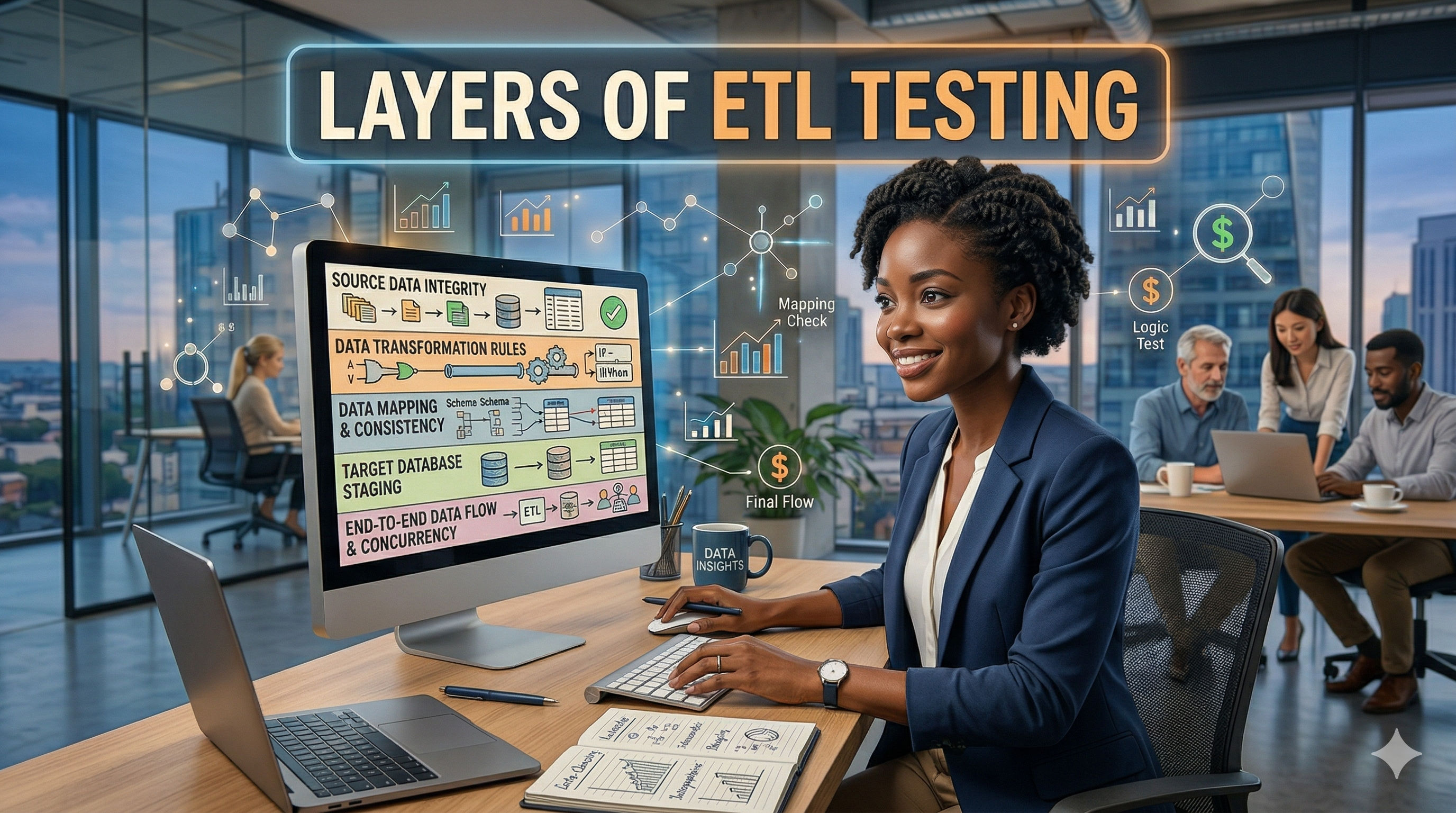
Table of Contents
In today's world, businesses run on data. But raw data is messy. To make it useful, we move it from one place to another using a process called ETL (Extract, Transform, Load).
However, how do you know if the data in your new system is actually correct? What if some rows went missing during the transfer? What if the calculations are wrong?
That's where ETL Testing comes in.
Think of it like building a house. You don't just paint the walls and call it a day. You check the foundation, the plumbing, the wiring, and the roof. Similarly, ETL Testing has layers.
Here are the 7 essential layers of ETL Testing you need to check before trusting your data.
Layer 1: Data Completeness (Is everything there?)
Before we check if the data is right, we need to check if all the data arrived.
The Goal: Ensure no records are lost in transit.
✅ The Checklist:
- Does the row count in the destination (Data Warehouse) match the source (Database)?
- Are there any duplicate records that snuck in?
- Are there any missing files or empty tables?
Layer 2: Data Accuracy (Is it the right value?)
This layer verifies that the data values haven't been corrupted during the move.
The Goal: Ensure the data in the target system matches the source system exactly.
✅ The Checklist:
- Compare a sample of specific customer names, addresses, or transaction IDs.
- Check financial figures (e.g., does the "Total Sale" in the warehouse match the "Total Sale" in the source database?).
- Validate that data types haven't changed (e.g., a Date field shouldn't become a Text field).
Layer 3: Data Transformation (Were the rules applied correctly?)
This is the heart of ETL. Often, data needs to be changed—or "transformed"—to fit its new home. For example, you might need to calculate a customer's full name by combining "First Name" and "Last Name" columns.
The Goal: Ensure all business logic and calculations are applied correctly.
✅ The Checklist:
- Check calculations (e.g., Price × Quantity = Total).
- Verify aggregations (e.g., sums, averages, counts).
- Check conditional logic (e.g., "If Salary > 50k, then Category = 'High Earner'").
🎯 Want to master ETL Testing hands-on?
Learn SQL, data validation, and ETL pipeline testing with real projects at Vika Technologies.
Layer 4: Data Quality (Is it clean and usable?)
Garbage in, garbage out. This layer checks the data itself for internal consistency and cleanliness.
The Goal: Identify dirty data that could break reports.
✅ The Checklist:
- Null/Blank Checks: Are there empty fields where there shouldn't be?
- Duplicate Checks: Is the same customer listed twice with different IDs?
- Invalid Data: Are there impossible dates (e.g., Date of Birth = 01/01/1800)?
- Are there negative numbers where only positive numbers should exist?
Layer 5: Data Consistency (Does it tell the same story?)
When data comes from multiple sources (e.g., Salesforce and Shopify), it needs to match up.
The Goal: Ensure data is integrated correctly and doesn't contradict itself.
✅ The Checklist:
- Does the "Customer ID" in the Sales table match the "Customer ID" in the Customer Info table?
- If the source system spells a country as "USA" and another as "United States," has the ETL process standardized them to one format?
Layer 6: Data Integrity (Are the relationships intact?)
Databases rely on relationships (Primary Keys and Foreign Keys). If these links break, your queries will return wrong results.
The Goal: Ensure the data relationships are preserved.
✅ The Checklist:
- Referential Integrity: Does every Order record have a valid Customer attached to it?
- Are there any orphan records (data that doesn't belong to a parent record)?
Layer 7: Performance & Regression (Is it fast, and is it still working?)
The final layer looks at the system as a whole.
The Goal: Ensure the ETL process runs efficiently and that new changes haven't broken old functionality.
✅ The Checklist:
- Performance: Does the ETL job finish within the allowed time window (e.g., before the business opens in the morning)?
- Regression: Last week, everything worked. We made a small change yesterday. Did that change accidentally break something else?
Conclusion
ETL Testing isn't just about running a few queries. It's a structured, multi-layered approach to ensuring your data is complete, accurate, transformed correctly, clean, consistent, relationally intact, and performant. By following these 7 layers as a checklist, you can build confidence that the data powering your business decisions is truly reliable.
Once your ETL pipeline is validated, the analyst's work begins. To understand how reliable data ultimately becomes business insight — descriptive, diagnostic, predictive, and prescriptive — read our deep-dive on what data analysis is and the four types every team uses.
If you're ready to build a career in data quality and ETL pipeline validation, explore our hands-on with real-world projects and 100% placement support.
Ready to Master ETL Testing?
Join Vika Technologies for hands-on training with placement support.
About the Author
Vika Tech Team
Industry experts delivering top-notch IT training in Trichy. We specialize in Data Analytics, Engineering, and Full Stack Development.
Frequently Asked Questions
What is ETL Testing?
ETL Testing is the process of verifying that data extracted from source systems is accurately transformed and loaded into the target data warehouse without any loss or corruption.
Why is ETL Testing important?
Without ETL Testing, businesses risk making decisions based on incomplete, inaccurate, or corrupted data. It ensures data reliability for reports, dashboards, and analytics.
What tools are used for ETL Testing?
Common tools include SQL for data validation, Informatica, Talend, SSIS for ETL processes, and specialized testing tools like QuerySurge and iCEDQ.
Can I become an ETL Tester without a coding background?
Yes! ETL Testing primarily requires strong SQL skills and an understanding of data flows. Our course teaches everything from scratch, making it accessible for beginners and career switchers.